Understand Diabetes
Learn about type 2 diabetes, prediabetes, and important risk factors.

Gbokoniyi Community Care
Rest-In-Hope Healthcare Services — Abeokuta
Know Your Sugar. Protect Your Health. Prevent Diabetes.
A 12-Week In-Person Community Health Education Program
Rest-In-Hope Healthcare Services, Adigbe, Abeokuta, Ogun State, Nigeria
Program in Development — Registration of Interest
At Gbokoniyi Community Care, we believe that preventing diabetes begins with knowledge, healthier daily habits, and meaningful community support.
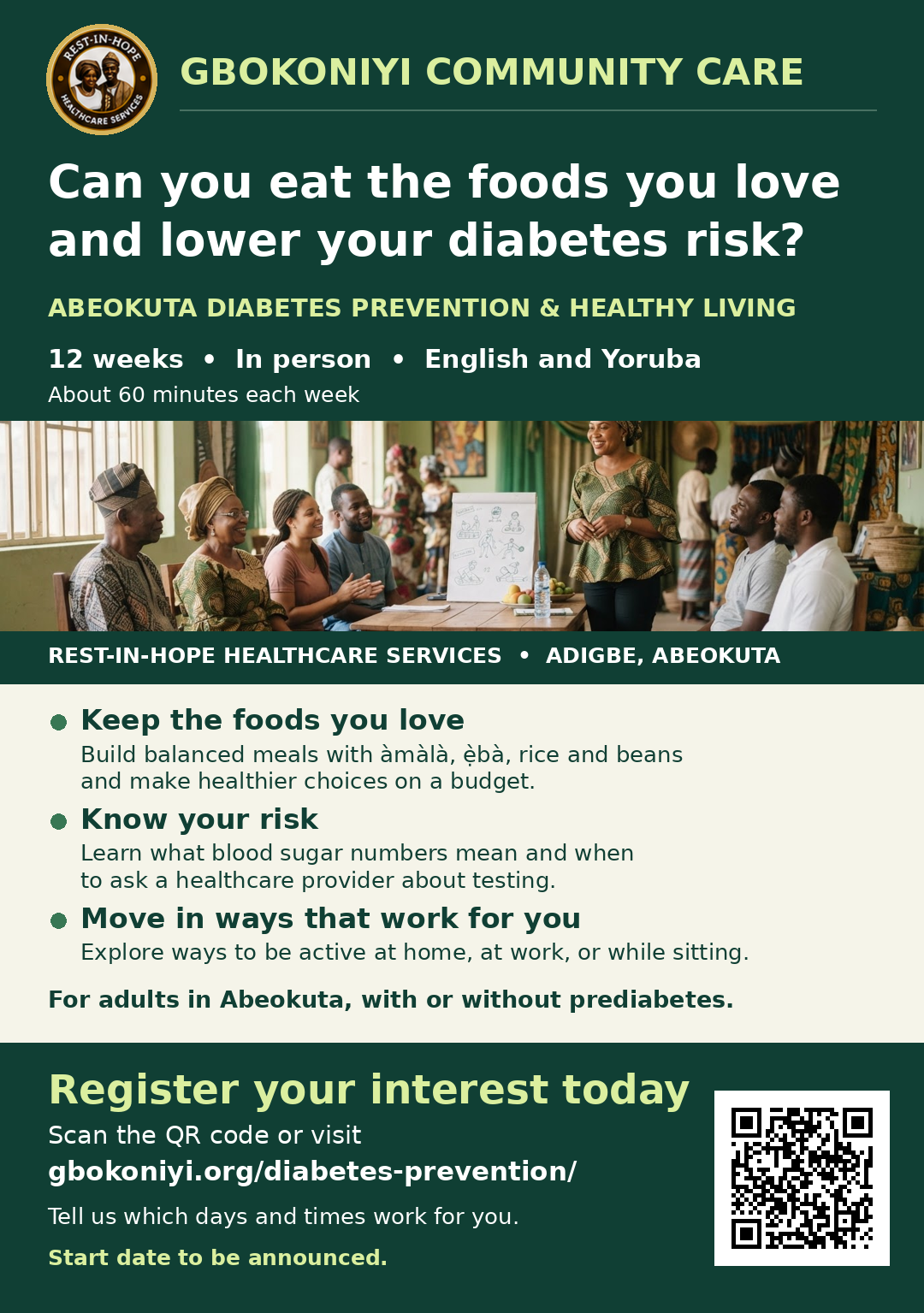
Our proposed 12-week program is designed to bring residents of Abeokuta together for practical diabetes prevention education at our Rest-In-Hope Healthcare Services location in Adigbe.
Participants will learn about diabetes risk factors, nutrition, physical activity, healthy weight management, and sustainable lifestyle changes using familiar Nigerian foods and practical everyday examples.
Learn about type 2 diabetes, prediabetes, and important risk factors.
Understand why professional blood sugar testing and medical follow-up may be important.
Learn how to prepare balanced meals with affordable Nigerian foods.
Develop safe movement habits that fit your ability and lifestyle.
Learn about weight management, sleep, stress, and long-term healthy living.
Take part in weekly educational meetings and choose whether to receive optional reminders.
Abeokuta, Ogun State
Participants will attend scheduled group health education sessions at our Rest-In-Hope Healthcare Services location in Adigbe, Abeokuta.
Our goal is to establish a welcoming community environment where residents can learn, ask general health questions, practise healthy habits, and receive guidance on accessing appropriate healthcare services.
Open any week to see the topic, learning goals, activity, and take-home idea.
Learn what type 2 diabetes and prediabetes mean and why early healthy habits matter.
Group activity: Sort simple examples into helpful and less helpful daily habits.
Try at home: Notice one routine you would like to improve.
Learning outcome: Participants can describe diabetes and one practical prevention step.
Explore blood sugar in everyday language and understand when a qualified provider may recommend testing.
Group activity: Discuss sample health scenarios and questions to ask a provider.
Try at home: Write down questions for your next healthcare visit.
Learning outcome: Participants can name personal risk factors to discuss with a provider.
Explore familiar foods and how variety, preparation, and portions can support balanced eating.
Group activity: Build a balanced plate using picture cards of local foods.
Try at home: Add a vegetable or other nourishing food to one meal.
Learning outcome: Participants can describe a balanced meal using familiar foods.
Learn simple, flexible ways to balance portions without giving up traditional foods.
Group activity: Practise arranging a sample meal on a plate.
Try at home: Try the plate-balance idea at one meal.
Learning outcome: Participants can plan a balanced meal with an appropriate portion.
Consider safe movement choices that fit different abilities, schedules, and work routines.
Group activity: Demonstrate gentle seated and standing movement options.
Try at home: Add brief, comfortable movement to the day if appropriate.
Learning outcome: Participants can select a safe activity to discuss or try.
Discuss body weight respectfully and focus on sustainable habits rather than quick fixes.
Group activity: Practise making a small, specific weekly goal.
Try at home: Track one chosen habit for several days.
Learning outcome: Participants can set a practical, non-judgmental health goal.
Learn how food and drink choices can support heart health and why blood pressure matters.
Group activity: Compare sample drink and food labels or illustrations.
Try at home: Choose water instead of a sweetened drink once, if suitable.
Learning outcome: Participants can identify one way to reduce excess sugar or salt.
Explore how rest and stress-management habits support overall wellbeing.
Group activity: Try a short guided breathing or quiet reflection exercise.
Try at home: Practise a chosen calming or bedtime routine.
Learning outcome: Participants can choose a healthy rest or stress-supporting habit.
Understand family history as one risk factor among several, without blame or stigma.
Group activity: Use a sample family story to practise discussing risk respectfully.
Try at home: Ask a trusted relative about family health history if comfortable.
Learning outcome: Participants can identify a useful health question to raise with a provider.
Explore affordable meal planning with seasonal foods and practical shopping choices.
Group activity: Create a sample low-cost meal plan as a group.
Try at home: Plan one affordable balanced meal for the coming week.
Learning outcome: Participants can identify budget-conscious healthy food options.
Learn safe general principles for discussing medicines and keeping healthcare appointments.
Group activity: Practise questions to ask at a healthcare visit; no personal medication review.
Try at home: Keep a list of questions for a qualified healthcare provider.
Learning outcome: Participants know not to start, stop, or change medicines without professional advice.
Review learning, celebrate effort, and plan ways to continue healthy routines.
Group activity: Complete a group learning review and share one useful takeaway.
Try at home: Choose one habit to continue and one support to seek.
Learning outcome: Participants leave with a realistic personal healthy-living plan.
Check in and receive educational materials.
Review lifestyle goals, challenges, and achievements.
Learn the scheduled diabetes prevention topic.
Explore food labels, balanced meals, or suitable movement.
Receive an activity and information about the next session.
Sessions are designed for health education and lifestyle support. Individual medical assessment, laboratory testing, diagnosis, and treatment must be obtained through appropriately licensed healthcare providers.
You do not need to abandon traditional foods. We will explore balanced meals, reasonable portions, food quality, and healthier cooking practices using familiar choices.
Market traders may build in short walking breaks; mechanics and artisans can stretch and move safely between tasks; older adults can choose gentle walking or seated movement; and people with limited mobility can ask a qualified provider about suitable options. Activities should fit individual abilities.

Participants will be encouraged to practise simple activities between weekly classes.
Attend the teaching session and set a personal goal.
Improve one food or beverage habit.
Prepare or choose a balanced Nigerian meal.
Complete appropriate physical activity.
Review a health education reminder.
Practise the weekly lesson and record progress.
Review achievements and prepare for the next session.
Assignments vary by topic and should be adapted to individual medical needs and abilities.
This educational program is intended primarily for adults living in Abeokuta who are interested in preventing type 2 diabetes.
✓ Adults who have been told they have prediabetes.
✓ Individuals with a family history of type 2 diabetes.
✓ People with overweight or obesity and other diabetes risk factors.
✓ Adults with high blood pressure or cholesterol concerns.
✓ Women with a history of gestational diabetes.
✓ Older adults interested in preventive healthcare.
✓ Individuals who want to improve nutrition and physical activity.
Participation in general health education does not require a prediabetes diagnosis. People already living with diabetes should continue professional medical management and may seek suitable general health education. We do not request diagnoses or sensitive medical details in this initial interest form.
Registration of Interest
Share your contact and scheduling preferences. Please do not include diagnoses or sensitive medical information.
Thank you for expressing interest in the Gbokoniyi Community Care Diabetes Prevention & Healthy Living Program in Abeokuta. Your information has been received for program planning and enrollment consideration. Our team will provide further information when the program schedule and registration arrangements are confirmed. Submission does not guarantee admission, clinical services, financial support, or other assistance.
Submissions are handled through B12 form management. Authorized staff can review inquiries through the website's form submissions tools; no public participant records or unconfigured messaging integrations are used.
Your details are requested only for program-interest planning and follow-up. Please do not submit medical diagnoses or sensitive health details. Access to submissions is managed through B12 form tools for authorized staff. You may contact us through the Contact page to ask about your information or request a correction or withdrawal.
A proposed 60-minute education session, with schedule details to be announced.
Participants check in and receive educational materials.
A brief review of lifestyle goals, challenges, and achievements.
The facilitator explains the scheduled diabetes prevention topic.
Examples include nutrition labels, balanced meals, or suitable movement.
Participants receive activity instructions and information about the next session.
Program in Development — Registration of Interest. Classes have not been announced as started; a submitted interest form is not confirmed enrollment.
Rest-In-Hope Healthcare Services is developing a community diabetes prevention education initiative in Abeokuta. Program information and lifestyle education are not substitutes for professional medical care.
Clinical testing, diagnosis, prescriptions, individualized treatment, and other regulated healthcare services will be available only through appropriately qualified and authorized healthcare providers. Program operations and on-site activities are subject to applicable facility and regulatory requirements.
Do not stop, start, or change medicines based on program materials. Consult an appropriately qualified healthcare provider for individual medical advice.
Gbokoniyi Community Care also works through educational and humanitarian initiatives that support vulnerable individuals and families. Residents seeking available community assistance are encouraged to explore our support programs. Assistance is subject to eligibility, availability, and organizational review.
Explore Community SupportLearn About Diabetes. Improve Your Habits. Protect Your Health.
Join our proposed 12-week in-person diabetes prevention education program in Abeokuta.
Register Your Interest TodayGbokoniyi Community Care
Rest-In-Hope Healthcare Services — Abeokuta
Serving with Compassion. Impacting Lives.